
Beyond Memorization: A New Blueprint for Education in the Ag
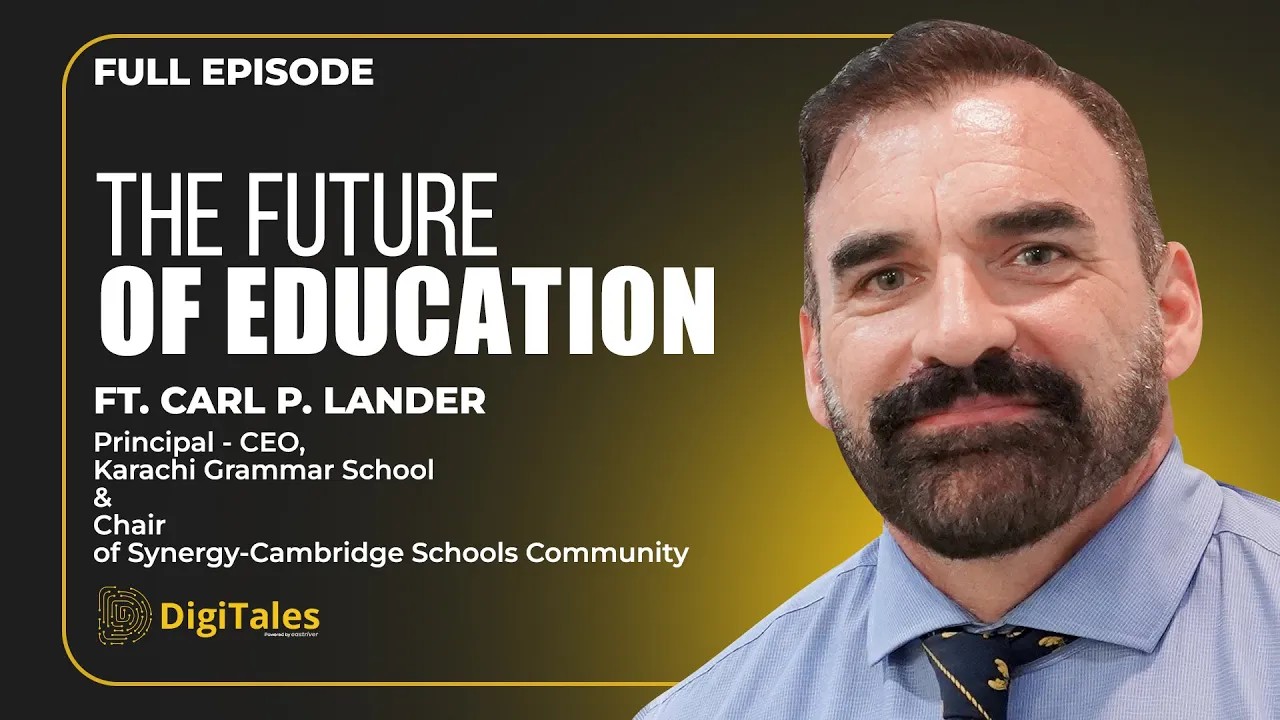
As someone who works with AI every day, I’ve found myself asking a fundamental question: is our education system preparing our children for a world where knowledge isn’t something you retain, but something you access? The old model of rote learning feels increasingly obsolete. To navigate this complex topic, I sat down for a fascinating conversation on Digitales with Carl Lander, the Principal of Karachi Grammar School and Chairperson of the Cambridge Schools Association. What he shared was not a prediction of doom, but an exciting blueprint for a necessary evolution.Carl argues that we are on the precipice of a monumental shift, one that AI is accelerating.
The People Question
The era of a “knowledge-centric” education system has run its course. The future doesn’t belong to the student who can memorize the periodic table, but to the one who can use it to solve a problem, collaborate with a team, and make sound decisions.This requires a fundamental rethinking of what we look for in a teacher. In one of the most powerful moments of our conversation, Carl made a crucial distinction. He said, “If you give me a PhD, you give me someone with specialist subject knowledge.
The Creative Dimension
If you give me a good human being, you give me someone I can put in front of a class that will be respected and is respectful. I can train them to be a teacher.” This is the core of his philosophy: education must start with character, empathy, and humanity. You can teach a good person chemistry; you can’t easily teach a chemist how to be a good person.To structure this new approach, Carl pointed to a landmark 1996 UN paper that identified four pillars of learning for the 21st century.
The Technology Bet
This framework, he believes, is more relevant now than ever. The goal of education should be to assess a student’s ability in four key areas:To Know: The foundational knowledge (the traditional focus).To Do: The application of that knowledge to solve real-world problems.To Be: The development of oneself as a person,discipline, teamwork, and integrity.To Decide: The ability to make critical, reasoned decisions under pressure.While systems like Cambridge have historically focused almost entirely on the “To Know,” Carl sees AI forcing a change. When any student can access information instantly, the value shifts to the other three pillars.
What Comes Next
He was surprisingly optimistic about Pakistan’s ability to adapt, noting a palpable “thirst for change” among parents and a new generation of bureaucrats that he feels is more potent here than in the more traditional, conservative systems of the West.Perhaps his most actionable advice was for students and parents grappling with the future of higher education. In a world where university costs are skyrocketing, he made a compelling, data-backed case for Pakistan’s top universities.
Institutions like NUST (ranked 353rd globally out of ~50,000) offer world-class programs and facilities. His advice was clear: unless you’re getting into a top-10 global institution like Harvard or MIT, consider getting your undergraduate degree from a top Pakistani university. Gain independence by moving to a different city within Pakistan, build a strong foundation, and then pursue a one-year Master’s degree abroad for the international network and experience.This conversation was a powerful reminder that the future of education isn’t about better memorization; it’s about building better humans.
Frequently Asked Questions
Carl P Lander is a prominent figure in business featured on the DigiTales podcast with Faizan Sayed, where they discussed their career, insights, and vision for Pakistan's future.
Carl P Lander discussed the state of Pakistan's creative sector on DigiTales, offering a firsthand account of the challenges artists face and the opportunities that remain for those willing to push boundaries.
DigiTales is a podcast hosted by Faizan Sayed, CEO of East River Digital, featuring weekly conversations with Pakistan's most influential leaders across business, culture, policy, and technology. The show covers real stories and hard-won insights from CEOs, artists, politicians, and entrepreneurs.
Guest: CARL P LANDER
Carl Lander is the Principal of Karachi Grammar School and Chairperson of the Cambridge Schools Association. With deep experience in international education frameworks, he is a leading voice on curriculum reform and AI's impact on education in Pakistan.
Host: Faizan Sayed
Faizan Sayed is the founder of DigiTales Podcast and CEO of East River Digital, a performance-led marketing agency with offices in Pakistan, KSA, and the US. Each week, he interviews Pakistan's most influential leaders across business, culture, and policy.
Category
- Arts & Culture (1)
- Automotive (3)
- Banking & Finance (1)
- Business & Economy (7)
- creative entrepreneurship (1)
- E-Commerce (1)
- Education (1)
- Entertainment (5)
- Entrepreneurship (4)
- Fashion (3)
- Food & Beverage (1)
- growth strategy (1)
- Human Resources (1)
- Insurance & Finance (1)
- Media & Content (2)
- Pakistan-India relations (1)
- Politics (4)
- Social Impact (2)
- Sports (1)
- Technology (1)
- Urban Planning (2)
Recent Post
-
Sheema Kermani: Dance, Culture, and Pakistan's Social Fabric
-
The Survival Playbook: How Ticketwala Launched into a Pandem
-
Zafar Masud on Banking, Rates, and Pakistan's Financial Future
-
The ROI of Hope: Wasif Ali Khan's Foundation for Pakistan's Hidden Talent
-
Liquid Gold: Decoding Karachi's Billion-Dollar Water Crisis
-
The Art of Perception: Syed Jawaid Iqbal on Shaping Reality
-
The Trapped Rat: Sunil Munj on Pakistan's Broken Auto Market
-
The Regulator Solution: Sohail Wajahat's Broken System Fix